
Beyond the Veil of Multiplicity: The Radical Non-Dualism of the Upanishads
In the landscape of human thought, most philosophies are bridges built to cross a river. The Upanishads, however, are the realization that there is no river, no bridge, and—most provocatively—no “you” to cross it.
Often referred to as Vedanta (the “end” or “culmination” of the Vedas), these ancient texts represent a seismic shift in Indian thought. They moved the seeker away from the external altars of ritual (Karma Kanda) and toward the internal laboratory of the mind (Jnana Kanda). To read the Upanishads is to engage in a “subversive” act of deconstructing the ego.
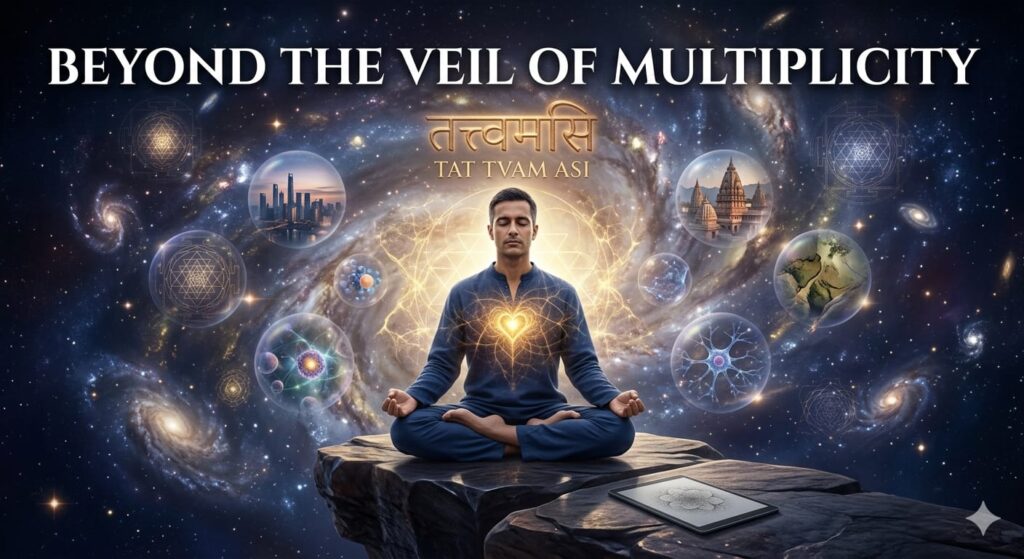
The Equations of Reality: Atman and Brahman
The central thesis of Upanishadic thought is not a belief system, but an ontological equation. At its heart lies the identity of the individual soul (Atman) with the ultimate, substratum of reality (Brahman).
Atman: Not the personality, the ego, or the memories, but the “witness-consciousness” (Sakshi) that remains constant while the body and mind fluctuate.
Brahman: The infinite, non-dual reality that is “without a second” (Ekamevadvitiyam).
The Upanishads don’t just suggest these are related; they declare them identical. This is captured in the Mahavakyas (Great Sayings), such as Tat Tvam Asi (“Thou Art That”). It suggests that the vast, cosmic intelligence you see “out there” is the exact same consciousness peering through your eyes “in here.”
The Mechanics of Maya: More Than Just “Illusion”
A common “high-level” misunderstanding is that Maya simply means the world is a fake hallucination. A more sophisticated reading, particularly from the Shvetashvatara Upanishad, suggests Maya is the creative power of the Absolute.
It is the principle of “appearance.” Just as a gold ornament is 100% gold regardless of whether it’s shaped like a ring or a necklace, the universe is 100% Brahman. Maya is simply the “name and form” (Nama-Rupa) that hides the underlying substance. To see the “gold” instead of just the “ring” is the beginning of wisdom.
The Four States of Consciousness
Perhaps the most “neuroscientific” contribution of the Upanishads comes from the Mandukya Upanishad, which analyzes the totality of human experience through four states:
Vaishvanara (Waking): Awareness of the external, material world.
Taijasa (Dreaming): Awareness of the internal, subtle world of thoughts and impressions.
Prajna (Deep Sleep): A state of “undifferentiated consciousness” where there is no duality, yet no awareness.
Turiya (The Fourth): This is the high-level “hack.” Turiya is not a fourth state to be reached, but the background screen upon which the other three states are projected. It is pure, contentless consciousness.
The Exit Strategy: Moksha as Cognitive Shift
In the Upanishads, liberation (Moksha) isn’t something that happens after death in a distant heaven. It is a radical cognitive shift—a “re-recognition” of one’s true nature. When the Katha Upanishad describes the dialogue between the young seeker Nachiketa and Yama (Death), the “secret” revealed isn’t about how to live forever; it’s about identifying with that which was never born. If you identify with the wave, you fear the shore. If you identify with the ocean, you are simply moving.
Why It Matters in 2026
Modern physics and consciousness studies are finally catching up to the Upanishadic intuition. As we grapple with the “Hard Problem of Consciousness”—how matter gives rise to mind—the Upanishads offer a bold reversal: Consciousness doesn’t arise from matter; matter is a modulation of consciousness.
Whether you are looking at the “observer effect” in quantum mechanics or the “ego-dissolution” in modern psychology, the Upanishads provide the original roadmap for understanding the non-local, unified nature of reality.
“The sun does not shine there, nor the moon and the stars, nor these lightnings, and much less this fire. When He shines, everything shines after Him; by His light all this is lighted.”
— Katha Upanishad.